
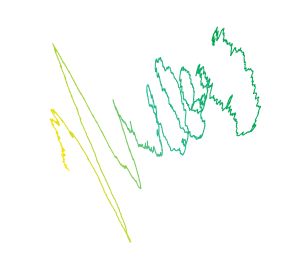
Riemann’s Zeta and Random Walks

The Riemann Zeta function is a function of a complex variable s that analytically continues the sum of the Dirichlet series

\zeta(s) = \sum\limits_{n=1}^{\infty} \frac{1}{n^s}

In 1737, the revered Swiss mathematician, Leonhard Euler, discovered the fundamental connection between the Zeta function and prime numbers. The proof is as follows, given

\zeta (s)=\sum\limits _{n=1}^{\infty }{\frac {1}{n^{s}}} = 1+{\frac {1}{2^{s}}}+{\frac {1}{3^{s}}}+{\frac {1}{4^{s}}}+{\frac {1}{5^{s}}}+\ldots     (1.1)

we will multiply both sides of the equation by {\frac {1}{2^{s}}}

{\frac {1}{2^{s}}}\zeta (s) = {\frac {1}{2^{s}}}+{\frac {1}{4^{s}}}+{\frac {1}{6^{s}}}+{\frac {1}{8^{s}}}+{\frac {1}{10^{s}}}+\ldots     (1.2)

then subtract (1.2) from (1.1) to remove all factors of 2

\left(1-{\frac {1}{2^{s}}}\right)\zeta (s)=1+{\frac {1}{3^{s}}}+{\frac {1}{5^{s}}}+{\frac {1}{7^{s}}}+{\frac {1}{9^{s}}}+{\frac {1}{11^{s}}}+{\frac {1}{13^{s}}}+\ldots

Repeating this for factors of 3

\frac {1}{3^{s}}\left(1-{\frac {1}{2^{s}}}\right)\zeta (s) = {\frac {1}{3^{s}}}+{\frac {1}{9^{s}}}+{\frac {1}{15^{s}}}+{\frac {1}{21^{s}}}+{\frac {1}{27^{s}}}+{\frac {1}{33^{s}}}+\ldots

\left(1-{\frac {1}{3^{s}}}\right)\left(1-{\frac {1}{2^{s}}}\right)\zeta (s)=1+{\frac {1}{5^{s}}}+{\frac {1}{7^{s}}}+{\frac {1}{11^{s}}}+{\frac {1}{13^{s}}}+{\frac {1}{17^{s}}}+\ldots

and so on. If we continue this process to infinity for \frac{1}{p^s}, where p is a prime, the expression reduces to

\ldots \left(1-{\frac {1}{11^{s}}}\right)\left(1-{\frac {1}{7^{s}}}\right)\left(1-{\frac {1}{5^{s}}}\right)\left(1-{\frac {1}{3^{s}}}\right)\left(1-{\frac {1}{2^{s}}}\right)\zeta (s) = 1

which can be rearranged to produce

\zeta(s) = \frac{1}{\left(1-{\frac {1}{2^{s}}}\right)\left(1-{\frac {1}{3^{s}}}\right)\left(1-{\frac {1}{5^{s}}}\right)\left(1-{\frac {1}{7^{s}}}\right)\left(1-{\frac {1}{11^{s}}}\right)+\ldots } = \prod\limits_{\forall p\:\in\:\mathrm{P}}^{\:} \frac{1}{1-p^{-s}}     (1.3)

So why are we doing all of this? Well, it turns out the reciprocal of the Zeta function has some remarkable properties of its own.

Consider the inverse based on Euler’s prime product formula

\frac{1}{\zeta(s)} = \prod\limits_{\forall p\:\in\:\mathrm{P}}^{\:} \left(1-p^{-s}\right) = \left(1-\frac{1}{2^s}\right)\left(1-\frac{1}{3^s}\right)\left(1-\frac{1}{5^s}\right)\ldots

expanding this expression we have

\frac{1}{\zeta(s)} = 1 + \sum_{n \text{ prime}} \left({\frac{-1} {n^s} }\right) + \sum_{n \mathop = p_1 p_2} \left({ \frac{-1}{p_1^s} \frac{-1} {p_2^s} }\right) + \sum_{n \mathop = p_1 p_2 p_3} \left({ \frac {-1} {p_1^s} \frac {-1} {p_2^s} \frac{-1}{p_3^s} }\right) + \ldots

which can be rearranged to demonstrate

\frac{1}{\zeta(s)} = 1 + \frac{-1}{2^s} + \frac{-1}{3^s} + \frac{0}{4^s} + \frac{-1}{5^s} + \frac{1}{6^s} + \frac{-1}{7^s} + \frac{0}{8^s} + \frac{0}{9^s} + \frac{1}{10^s} + \frac{-1}{11^s} + \ldots     (1.4)

On close examination one can see that the numerator in (1.4) actually corresponds to the values of the Möbius function \mu(x). Indeed, the reciprocal of the Zeta function can be formally defined by

\frac{1}{\zeta(s)} = \sum\limits_{n=1}^{\infty} \frac{\mu(n)}{n^s}

This means that we can indeed deploy Riemann’s Zeta function to model a random walk.

Leave a comment