
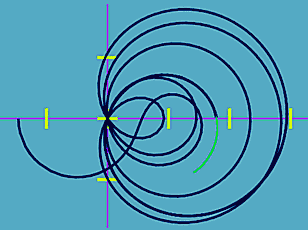
Zeta-Mobius Arithmetic Volatility: An Option-Pricing Extension
Classical option pricing usually begins with a diffusion model for the underlying asset price:

The central modeling question is not only the drift or the payoff. It is the volatility input. In the classical Black-Scholes model, volatility is constant or estimated from historical data. In stochastic-volatility and rough-volatility models, volatility becomes its own random process. The extension developed here introduces a different state variable: arithmetic residual energy generated by a zeta-Mobius transform.
The purpose is not to replace arbitrage-free pricing. The purpose is to replace the volatility estimate inserted into a standard pricing map.
1. The Source Construction
For 

Euler’s product formula expresses the same object through the primes:

Taking the reciprocal gives:

Expanding this product produces the Mobius function:

The Mobius function takes three possible values:
.
when
is the product of
distinct primes.
when
This is the mathematical source of the model. The sequence 
2. The Causal Zeta-Mobius Transform
Let 

For truncation depth 

=\sum_{n=1}^{N}\frac{\mu(n)}{n^s}X(t-n)](https://s0.wp.com/latex.php?latex=%5Cdisplaystyle+Z_s%5BX%5D%28t%29%3D%5Csum_%7Bn%3D1%7D%5E%7BN%7D%5Cfrac%7B%5Cmu%28n%29%7D%7Bn%5Es%7DX%28t-n%29&bg=ffffff&fg=404040&s=0&c=20201002)
A normalized version can also be used:

![\displaystyle Z_t^{(N,s)}[X]=\sum_{n=1}^{N}\widetilde{w}_n^{(N,s)}X_{t-n}](https://s0.wp.com/latex.php?latex=%5Cdisplaystyle+Z_t%5E%7B%28N%2Cs%29%7D%5BX%5D%3D%5Csum_%7Bn%3D1%7D%5E%7BN%7D%5Cwidetilde%7Bw%7D_n%5E%7B%28N%2Cs%29%7DX_%7Bt-n%7D&bg=ffffff&fg=404040&s=0&c=20201002)
This version is causal because it uses only observations available before time 
3. The Arithmetic-Sieve Residual Theorem
Theorem. Let ![Z_t^{(N,s)}[X]](https://s0.wp.com/latex.php?latex=Z_t%5E%7B%28N%2Cs%29%7D%5BX%5D&bg=ffffff&fg=404040&s=0&c=20201002)
The interpretation is simple. Ordinary local noise should partly cancel under the arithmetic sieve. Structured crowding, liquidity stress, volatility clustering, hidden periodicity, or adversarial bursts may survive as residual energy.
This leads to the residual-energy statistic:
\right|^2](https://s0.wp.com/latex.php?latex=%5Cdisplaystyle+E_Z%28t%29%3D%5Csum_j%5Cleft%7CZ_%7Bs_j%7D%5BX%5D%28t%29%5Cright%7C%5E2&bg=ffffff&fg=404040&s=0&c=20201002)
In a multi-channel setting, this becomes:
![\displaystyle E_Z(t)=\sum_{\ell=1}^{d}\sum_{N}\sum_s\omega_{\ell,N,s}\left(Z_t^{(N,s)}[X^{(\ell)}]\right)^2](https://s0.wp.com/latex.php?latex=%5Cdisplaystyle+E_Z%28t%29%3D%5Csum_%7B%5Cell%3D1%7D%5E%7Bd%7D%5Csum_%7BN%7D%5Csum_s%5Comega_%7B%5Cell%2CN%2Cs%7D%5Cleft%28Z_t%5E%7B%28N%2Cs%29%7D%5BX%5E%7B%28%5Cell%29%7D%5D%5Cright%29%5E2&bg=ffffff&fg=404040&s=0&c=20201002)
This quantity is not merely realized volatility. It is arithmetic residual energy: the energy left over after a prime-factorization-driven cancellation filter has acted on the market signal.
4. From Residual Energy to Volatility
The simplest arithmetic-volatility specification is:

where 
For empirical option pricing, it is often more stable to start with a base volatility estimate and apply the arithmetic adjustment multiplicatively:

Here 
5. Proposition: Positivity and Modularity
Proposition. If 


is a positive volatility estimator. It can be inserted directly into a standard option-pricing equation without changing the payoff function.
- Positivity: the square-root form preserves nonnegative volatility.
- Modularity: the zeta-Mobius term changes the volatility input, not the option payoff.
- Interpretability: the volatility premium is driven by structured arithmetic residual energy.
6. Black-Scholes with Arithmetic Volatility
The Black-Scholes call price is:

with


The zeta-Mobius extension keeps this pricing map but replaces 


The interpretation is that zeta-Mobius residual energy supplies a volatility state variable. It does not replace no-arbitrage pricing. It modifies the volatility estimate that enters the no-arbitrage pricing equation.
7. Calibrated Arithmetic Volatility
A more practical version estimates the volatility map from data:

where 
The corresponding option price is:

8. Interpretation
The economic interpretation is that market volatility is not only Brownian, stochastic, or rough. It may also contain arithmetic structure produced by discrete market activity. Markets are made of clustered trades, orders, cancellations, liquidity shocks, and heterogeneous horizons. The zeta-Mobius transform is designed to test whether some part of that structure survives arithmetic cancellation.
- Brownian volatility captures continuous random fluctuation.
- Rough volatility captures persistent irregularity and memory.
- Zeta-Mobius arithmetic volatility captures structured residual disorder after Mobius cancellation.
The model is therefore best viewed as an additional volatility-state variable. It can be used alongside realized volatility, implied volatility, EWMA volatility, GARCH, HAR-RV, rough volatility, or other volatility estimators.
9. Practical Pricing Hypothesis
The practical hypothesis is:
Option prices improve when the volatility input includes arithmetic residual energy that anticipates future realized variance better than rolling volatility alone.
This gives a concrete testing procedure:
- Compute a market signal
- Apply the zeta-Mobius transform across several values of
- Construct
or a standardized feature
- Estimate
.
- Insert the resulting volatility into Black-Scholes or another pricing map.
- Compare out-of-sample volatility and option-price error against rolling volatility, EWMA, GARCH, HAR-RV, and implied-volatility baselines.
10. Summary
The zeta-Mobius option-pricing extension can be summarized in three equations:
In calibrated form, the volatility model becomes:
The broader point is that financial markets are discrete, clustered, adversarial, and multi-scale. The Mobius function provides a deterministic arithmetic sieve for extracting residual structure from such systems. In option pricing, that residual structure becomes a candidate volatility state variable.
This is the central idea of zeta-Mobius arithmetic volatility.

